Industrial Bearings Explained: Types, Uses, Benefits, and Maintenance Guide
Industrial bearings are among the most important components used in machines across manufacturing, construction, transportation, agriculture, mining, and energy industries. Although bearings are often small compared to the machines they support, they play a major role in helping equipment operate smoothly, reduce friction, and carry heavy loads during continuous operation.
From conveyor systems and electric motors to pumps, turbines, compressors, and industrial robots, bearings are found in nearly every rotating machine. Their design allows moving parts to rotate or slide with minimal resistance, improving efficiency while reducing wear and extending equipment life.
As industries continue adopting automation and smart manufacturing, the demand for reliable, durable, and high-performance industrial bearings continues to grow. Understanding how bearings work, the different types available, and proper maintenance practices helps businesses and technical professionals improve equipment reliability and reduce downtime.
Understanding Industrial Bearings and Their Purpose
An industrial bearing is a mechanical component designed to support rotating or moving parts while minimizing friction between surfaces. It helps guide movement in a controlled direction and supports loads generated during machine operation.
Whenever a shaft rotates inside a machine, bearings create a smooth interface between the shaft and the housing. Instead of metal surfaces rubbing directly against each other, rolling elements or specially designed sliding surfaces carry the load. This reduces heat generation, energy loss, and mechanical wear.
Industrial bearings are engineered to operate under different conditions, including high speed, heavy loads, extreme temperatures, moisture, dust, chemicals, and vibration. The correct bearing design depends on the machine's operating environment and performance requirements.
Why Industrial Bearings Are Essential in Modern Industries
Modern industrial systems rely on bearings because they improve both machine performance and operational efficiency. Without bearings, rotating machinery would experience excessive friction, leading to rapid component failure and increased maintenance needs.
Bearings help improve productivity by allowing machines to operate continuously with consistent motion. They reduce energy consumption by minimizing resistance during rotation and help maintain accurate alignment between moving components.
In industries where equipment runs for long hours, reliable bearings also contribute to workplace safety by reducing unexpected mechanical failures. Their performance directly affects the lifespan of motors, gearboxes, pumps, fans, conveyors, and production equipment.
How Industrial Bearings Work
Industrial bearings work by reducing direct contact between moving machine parts. Depending on the bearing design, rolling balls, cylindrical rollers, tapered rollers, needles, or sliding surfaces transfer loads while allowing movement.
When a rotating shaft turns, the bearing distributes radial loads, axial loads, or both. Lubrication creates a protective layer that further reduces friction and prevents metal-to-metal contact.
The basic operation involves several components working together.
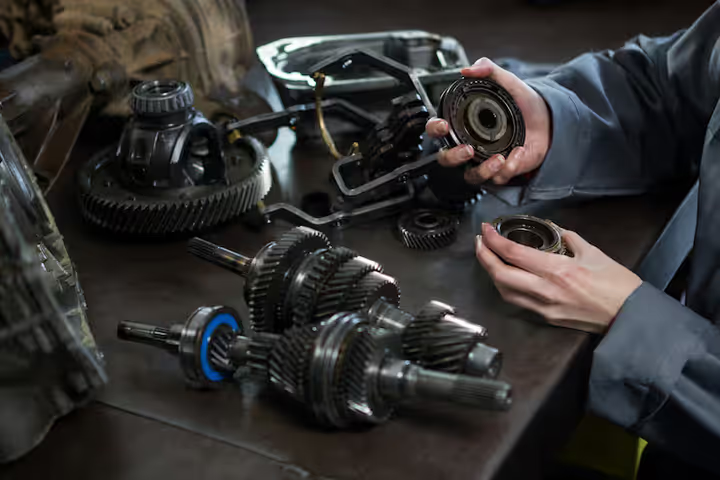
The inner ring fits onto the rotating shaft, while the outer ring remains fixed within the housing. Rolling elements move between these rings inside a cage that maintains proper spacing and smooth rotation. Lubrication helps dissipate heat, reduce wear, and protect against corrosion.
This simple yet highly engineered mechanism allows industrial machinery to operate efficiently under demanding conditions.
Main Types of Industrial Bearings
Different industrial applications require different bearing designs based on load direction, speed, precision, and operating environment.
Ball Bearings
Ball bearings are among the most widely used industrial bearings because they handle moderate radial and axial loads while operating efficiently at high speeds.
They are commonly used in electric motors, fans, pumps, compressors, conveyors, and automation equipment. Their versatility makes them suitable for many general-purpose industrial applications.
Roller Bearings
Roller bearings use cylindrical rolling elements instead of balls, allowing them to support heavier radial loads.
These bearings are commonly found in industrial gearboxes, conveyor systems, heavy machinery, steel manufacturing equipment, and mining operations where durability is important.
Tapered Roller Bearings
Tapered roller bearings support both radial and axial loads simultaneously. Their design makes them ideal for equipment exposed to combined forces.
They are frequently used in automotive manufacturing, industrial transmissions, construction equipment, railway systems, and heavy rotating machinery.
Needle Bearings
Needle bearings use long, thin rollers that provide high load capacity within compact spaces.
They are commonly installed in gearboxes, machine tools, textile equipment, agricultural machinery, and compact mechanical assemblies.
Thrust Bearings
Thrust bearings primarily support axial loads generated along the shaft's direction.
These bearings are commonly used in turbines, cranes, vertical pumps, rotating tables, and industrial lifting equipment.
Plain Bearings
Plain bearings operate without rolling elements. Instead, sliding surfaces reduce friction through specialized materials and lubrication.
They are suitable for applications involving oscillating motion, slow rotational speeds, hydraulic equipment, heavy construction machinery, and industrial presses.
Common Materials Used in Industrial Bearings
The material used to manufacture bearings significantly affects strength, durability, corrosion resistance, and operating life.
High-carbon chromium steel remains the most common bearing material because it offers excellent hardness and fatigue resistance. Stainless steel bearings provide better corrosion resistance for food processing, pharmaceutical, and marine environments.
Ceramic bearings are valued for lightweight construction, electrical insulation, and resistance to high temperatures. Hybrid bearings combine ceramic rolling elements with steel rings for improved speed and durability.
Some industrial bearings also use bronze, brass, engineered polymers, or composite materials for specialized applications requiring chemical resistance or reduced lubrication.
Where Industrial Bearings Are Used
Industrial bearings support equipment across nearly every manufacturing and processing sector. Their applications vary depending on machine design and operating conditions.
Industry | Typical Bearing Applications |
| Manufacturing | Conveyor systems, motors, gearboxes, assembly machines |
| Mining | Crushers, vibrating screens, heavy conveyors, drilling equipment |
| Construction | Excavators, loaders, cranes, concrete mixers |
| Agriculture | Harvesters, tractors, irrigation systems, processing equipment |
| Energy | Wind turbines, generators, compressors, turbines |
| Food Processing | Packaging machines, mixers, conveyors, refrigeration systems |
| Robotics and Automation | Robotic arms, linear motion systems, precision equipment |
Each application requires bearings that match environmental conditions, operating loads, lubrication requirements, and expected service life.
Choosing the Right Industrial Bearing
Selecting an appropriate bearing begins with understanding the machine's operating requirements. Every application has different speed, load, temperature, contamination, and alignment conditions.
Load capacity is one of the first considerations. Machines carrying heavy radial loads require different bearings than equipment handling primarily axial loads.
Operating speed also matters because certain bearing designs generate less heat and perform better during high-speed rotation.
Environmental conditions influence bearing selection as well. Dusty mining operations require sealed bearings, while food processing facilities often need corrosion-resistant bearings suitable for frequent cleaning.
Precision applications such as CNC machines and robotics demand bearings with tighter manufacturing tolerances for accurate movement and reduced vibration.
Choosing the correct bearing improves equipment efficiency and helps reduce maintenance frequency over the long term.
Lubrication and Its Role in Bearing Performance
Lubrication is essential for maintaining industrial bearing performance. Proper lubrication reduces friction, removes heat, protects against corrosion, and prevents premature wear.
Grease lubrication is commonly used because it remains inside sealed bearings and requires less frequent maintenance. Oil lubrication is preferred in high-speed or continuously operating equipment because it provides better cooling and contaminant removal.
Automatic lubrication systems are increasingly used in industrial facilities to deliver controlled lubricant quantities at scheduled intervals, improving maintenance consistency.
Using the correct lubricant type and maintaining appropriate lubrication intervals helps extend bearing life and reduce unexpected failures.
Common Causes of Bearing Failure
Industrial bearings are designed for long operating life, but several factors can shorten their lifespan if not managed properly.
Insufficient lubrication increases friction and heat, accelerating wear. Contamination from dust, moisture, or chemicals damages bearing surfaces and reduces performance.
Improper installation may create excessive preload or misalignment, leading to uneven load distribution. Overloading beyond the bearing's design capacity causes fatigue damage over time.
Excessive vibration, electrical currents in motors, corrosion, and operating temperatures outside recommended ranges can also contribute to premature failure.
Understanding these causes helps maintenance teams identify issues before they result in equipment downtime.
Signs That an Industrial Bearing Needs Attention
Bearings often provide warning signs before complete failure occurs. Monitoring equipment condition allows maintenance teams to replace bearings before significant machine damage develops.
Unusual grinding or humming noises during operation often indicate internal wear. Increased vibration levels may signal damaged rolling elements or misalignment.
Higher operating temperatures can result from lubrication problems or excessive friction. Reduced machine efficiency, inconsistent rotation, or visible lubricant leakage may also indicate bearing issues.
Regular condition monitoring helps detect these symptoms early and supports predictive maintenance strategies.
Best Practices for Industrial Bearing Maintenance
Proper maintenance significantly improves bearing reliability and equipment lifespan. Preventive maintenance focuses on inspection, lubrication, cleaning, alignment, and condition monitoring.
Routine inspections help identify contamination, corrosion, unusual noise, or vibration before failures occur. Keeping bearing housings clean reduces the risk of particles entering internal components.
Correct installation techniques prevent damage during mounting and ensure proper alignment. Monitoring lubrication schedules helps maintain consistent protection against friction and heat.
Many industrial facilities now use vibration analysis, temperature monitoring, ultrasonic inspection, and oil analysis as predictive maintenance tools to detect developing bearing problems without stopping production.
Recent Developments in Industrial Bearings During 2025–2026
Industrial bearing technology has continued evolving alongside automation, energy efficiency, and predictive maintenance trends.
Manufacturers have introduced bearings with improved sealing systems that provide better protection against contamination in demanding environments. Smart bearings equipped with embedded sensors are becoming more common in automated factories, allowing real-time monitoring of temperature, vibration, and rotational speed.
Demand has also increased for bearings designed for electric motors, renewable energy equipment, industrial robotics, and high-efficiency manufacturing systems.
Sustainability has become another focus area, with longer-life lubrication systems, recyclable materials, and designs that reduce energy losses during operation.
These developments support Industry 4.0 initiatives and help organizations improve equipment reliability through data-driven maintenance.
Industrial Bearings and Predictive Maintenance
Predictive maintenance has changed how industries manage bearing health. Instead of replacing bearings after failure or on fixed schedules, facilities increasingly monitor bearing condition continuously.
Sensors measure vibration, temperature, rotational speed, and acoustic signals during machine operation. Software analyzes this information to identify patterns associated with wear or lubrication issues.
This approach helps maintenance teams schedule replacements during planned shutdowns instead of responding to unexpected breakdowns.
Predictive maintenance also reduces maintenance costs, minimizes production interruptions, and extends equipment life by identifying problems at an earlier stage.
Environmental Factors That Affect Bearing Life
Operating conditions have a significant influence on bearing performance and durability.
High temperatures may reduce lubricant effectiveness and increase wear. Moisture can lead to corrosion if bearings are not adequately sealed. Dust and abrasive particles create surface damage when contamination enters the bearing.
Chemical exposure requires specialized materials and seals that resist corrosion. Heavy vibration and shock loads increase mechanical stress and may shorten fatigue life.
Selecting bearings designed for the intended operating environment helps improve long-term reliability.
Future Outlook for Industrial Bearings
Industrial bearings are expected to become increasingly intelligent, efficient, and durable as manufacturing technologies continue advancing.
Future bearing designs will likely integrate more condition-monitoring capabilities, allowing equipment to communicate maintenance requirements automatically. Advanced materials may improve resistance to corrosion, heat, and wear while supporting higher operating speeds.
Automation, robotics, renewable energy systems, and electric industrial equipment will continue driving demand for specialized bearing solutions optimized for precision and continuous operation.
As industries focus on energy efficiency and sustainability, bearing technology will remain an important part of improving machine performance and reducing operational losses.
Conclusion
Industrial bearings are fundamental components that support the movement, efficiency, and reliability of industrial machinery across countless sectors. By reducing friction, carrying loads, and maintaining smooth rotation, they help machines operate safely and efficiently under a wide range of operating conditions.
Understanding different bearing types, materials, applications, lubrication methods, maintenance practices, and recent technological developments helps users make informed decisions about equipment care and performance. Regular inspection, proper lubrication, correct installation, and predictive maintenance strategies can significantly extend bearing life and reduce unexpected downtime.
As manufacturing continues adopting automation and smart maintenance technologies, industrial bearings will remain a critical part of modern industrial systems, contributing to productivity, equipment longevity, and operational efficiency.