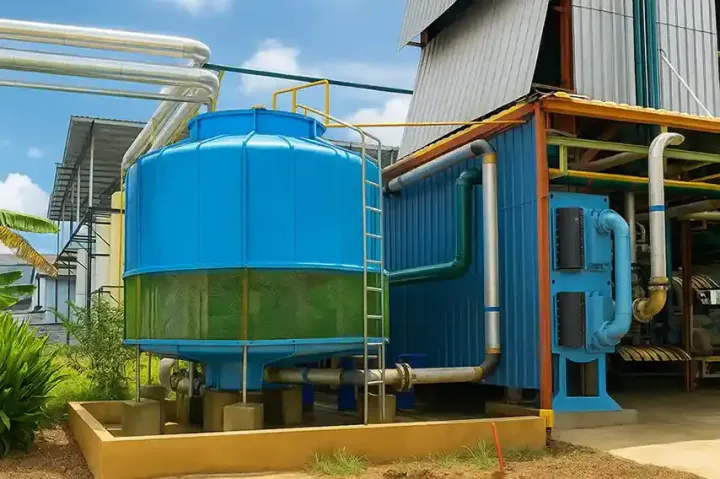
Industrial Cooling Towers Explained: Types, Working Process, Benefits and Modern Applications
Industrial cooling towers play an essential role in keeping factories, manufacturing plants, power stations, and commercial facilities operating safely and efficiently. Many industrial processes generate large amounts of heat, and without an effective cooling system, equipment can overheat, production efficiency can decline, and operating costs can increase. Cooling towers help solve this challenge by removing unwanted heat from water and releasing it into the atmosphere through a controlled cooling process.
Although cooling towers are commonly associated with large industrial facilities, they are also used in commercial buildings, data centers, chemical plants, food processing facilities, and many other industries where temperature control is critical. As industries continue to focus on energy efficiency and sustainable operations, cooling tower technology has evolved to improve performance while reducing water and energy consumption.
This guide explains industrial cooling towers in simple language, covering their working principle, different types, major components, applications, maintenance requirements, and recent developments.
What Is an Industrial Cooling Tower?
An industrial cooling tower is a heat rejection system designed to cool water that has absorbed heat from industrial equipment or manufacturing processes. Instead of continuously using fresh water, cooling towers allow water to circulate through a cooling loop, making the process more efficient and environmentally responsible.
The basic purpose of a cooling tower is to transfer excess heat from warm water into the surrounding air. As water flows through the tower, a small portion evaporates. This evaporation removes heat from the remaining water, lowering its temperature before it returns to the industrial process.
Cooling towers are often part of a larger cooling water system that includes pumps, heat exchangers, piping, fans, and monitoring equipment. Together, these components maintain stable temperatures for machinery and industrial operations.
Why Industrial Cooling Towers Are Important Today
Modern industries rely heavily on cooling systems because many machines and production processes operate at high temperatures. Cooling towers help maintain consistent operating conditions, which improves equipment reliability and extends machinery lifespan.
Temperature control also supports product quality in industries where manufacturing conditions must remain stable. For example, chemical processing, pharmaceutical production, and food manufacturing often require precise temperature management throughout production.
Another important reason cooling towers matter is resource efficiency. Recycling cooling water reduces overall water demand compared to once-through cooling systems. This approach helps industries manage water resources more effectively while supporting environmental sustainability goals.
As industrial automation expands and facilities become larger, dependable cooling infrastructure has become an important part of operational planning.
How Industrial Cooling Towers Work
The working principle of an industrial cooling tower is based on heat exchange and evaporation. Warm water enters the cooling tower after collecting heat from industrial equipment. Inside the tower, the water is distributed over fill material that increases its contact with air.
Air moves through the tower either naturally or with mechanical fans. As air passes over the water, a small percentage of water evaporates. Evaporation absorbs heat, reducing the temperature of the remaining water.
The cooled water collects in a basin at the bottom of the tower and is pumped back into the cooling system. This cycle continues continuously while industrial equipment is operating.
The effectiveness of a cooling tower depends on several factors, including ambient air temperature, humidity, airflow, water flow rate, and tower design.
Main Components of an Industrial Cooling Tower
Industrial cooling towers contain several important components that work together to maintain cooling performance.
The tower structure supports the entire cooling system and protects internal components from environmental conditions. Water distribution systems spread warm water evenly across the fill media for consistent cooling.
Fill media increases the surface area where water and air interact. This improves heat transfer efficiency and allows more effective cooling through evaporation.
Fans create airflow in mechanical draft cooling towers. Depending on the tower design, fans either pull air through the tower or push air into it.
Drift eliminators reduce water droplets escaping with exhaust air. This helps minimize water loss and protects surrounding equipment.
Cold water basins collect cooled water before it is recirculated into industrial processes.
Each component contributes to overall cooling efficiency and system reliability.
Different Types of Industrial Cooling Towers
Industrial cooling towers come in different designs depending on cooling capacity, available space, environmental conditions, and industrial requirements.
Natural Draft Cooling Towers
Natural draft cooling towers use the natural movement of warm air instead of mechanical fans. Their tall hyperbolic structure creates airflow through the chimney effect.
These towers are commonly used in power generation facilities because they can handle very large cooling loads with relatively low fan energy consumption.
Mechanical Draft Cooling Towers
Mechanical draft cooling towers use fans to move air through the tower. They are the most common type in manufacturing industries because they provide greater control over airflow and cooling performance.
Mechanical draft towers are available in various sizes and can be installed in facilities with limited space.
Crossflow Cooling Towers
In crossflow cooling towers, water flows downward while air moves horizontally across the fill media. This design allows easier maintenance because water distribution systems remain accessible.
Crossflow towers are widely used in commercial and industrial facilities that require consistent cooling with relatively simple maintenance.
Counterflow Cooling Towers
Counterflow cooling towers move air upward while water flows downward, creating opposite flow directions. This arrangement often improves heat transfer efficiency and allows a more compact tower design.
Counterflow towers are commonly selected when space is limited and higher cooling performance is required.
Open Circuit and Closed Circuit Cooling Towers
Cooling towers are also categorized by how water interacts with the cooling air.
Open Circuit Cooling Towers
Open circuit cooling towers expose circulating water directly to air. Heat is removed through evaporation, making this the most widely used cooling tower configuration in industrial applications.
Because water is exposed to the atmosphere, water treatment is important to control scaling, corrosion, and biological growth.
Closed Circuit Cooling Towers
Closed circuit cooling towers keep process fluid enclosed inside a coil while external water circulates around it. Heat transfers through the coil without direct contact between process fluid and outside air.
This design helps protect sensitive equipment and reduces contamination risks in industries that require cleaner cooling systems.
Where Industrial Cooling Towers Are Used
Industrial cooling towers support a wide range of industries that require continuous temperature management.
Power plants use cooling towers to remove heat generated during electricity production. Manufacturing industries rely on cooling towers to cool machinery, molds, compressors, and production equipment.
Chemical and petrochemical facilities use cooling towers to maintain safe processing temperatures during chemical reactions.
Food and beverage manufacturing uses cooling towers to support refrigeration systems and production equipment while maintaining product quality.
Pharmaceutical plants depend on stable cooling conditions during production and storage processes.
Data centers increasingly use cooling towers as part of large-scale cooling systems that protect servers from overheating.
Commercial buildings also use cooling towers for central air conditioning systems, particularly in large office buildings, hospitals, airports, and shopping centers.
Benefits of Industrial Cooling Towers
Industrial cooling towers provide several operational and environmental advantages.
One major benefit is improved equipment performance. Maintaining proper operating temperatures reduces overheating and helps machinery function consistently over long periods.
Cooling towers also improve energy efficiency by reducing the workload on chillers and other cooling equipment.
Water reuse is another significant advantage. Instead of constantly consuming fresh water, cooling systems recirculate water through multiple cooling cycles.
Consistent cooling supports production stability, especially in industries where temperature fluctuations can affect manufacturing quality.
Modern cooling towers are also designed to support sustainability initiatives through improved water management and energy-efficient operation.
Water Treatment in Cooling Towers
Water quality plays an important role in cooling tower performance. Because water continuously circulates and evaporates, minerals and contaminants become concentrated over time.
Without proper treatment, scale can form on heat exchange surfaces, reducing cooling efficiency. Corrosion can damage metal components, shortening equipment lifespan.
Biological growth such as algae, bacteria, and biofilm can reduce water flow and create maintenance challenges.
Industrial cooling systems typically include filtration, chemical treatment, monitoring sensors, and periodic cleaning to maintain water quality.
Maintaining balanced water chemistry helps improve cooling efficiency and protects cooling tower components.
Cooling Tower Maintenance and Inspection
Regular maintenance helps cooling towers operate safely and efficiently throughout the year.
Routine inspections include checking fans, motors, pumps, belts, and bearings for signs of wear. Water distribution systems should be inspected to ensure even flow across the fill material.
Cleaning fill media removes accumulated debris that can reduce airflow and cooling performance.
Water basins should be cleaned periodically to remove sediment and biological buildup.
Monitoring water chemistry allows operators to detect scaling, corrosion, or contamination before major issues develop.
Preventive maintenance reduces unexpected downtime and helps industrial facilities maintain reliable cooling performance.
Factors That Affect Cooling Tower Efficiency
Several environmental and operational conditions influence cooling tower performance.
Outdoor air temperature directly affects cooling capability because cooler air improves heat rejection.
Humidity is another important factor. High humidity reduces evaporation efficiency, making cooling towers less effective during humid weather.
Airflow volume influences how much heat can be removed from circulating water. Proper fan operation is important for maintaining adequate airflow.
Water distribution must remain balanced across the fill media to maximize heat exchange.
Clean internal components also improve efficiency by preventing airflow restrictions and insulating deposits.
Regular monitoring helps operators optimize these factors throughout changing seasonal conditions.
Recent Developments in Industrial Cooling Tower Technology
Over the past year, industrial cooling technology has continued moving toward smarter and more sustainable operation.
Many facilities have adopted digital monitoring systems that continuously track water temperature, conductivity, flow rates, vibration, and energy consumption. These systems help maintenance teams identify performance changes before equipment failures occur.
Variable-speed fan technology has become increasingly common because it adjusts airflow according to cooling demand instead of operating fans at full speed continuously. This helps reduce electricity consumption during periods of lower cooling requirements.
Water conservation technologies have also expanded, including improved drift eliminators, automated blowdown control, and advanced filtration systems that reduce unnecessary water loss.
Manufacturers are introducing corrosion-resistant materials and longer-lasting composite components designed to withstand harsh industrial environments while reducing maintenance needs.
These innovations support more efficient cooling operations and better resource management across industrial facilities.
Environmental Considerations and Sustainability
Industrial cooling towers are increasingly designed with environmental responsibility in mind.
Reducing water waste has become a major priority, particularly in regions facing water scarcity. Improved water management systems help maximize reuse while maintaining water quality.
Energy-efficient fan systems reduce electricity consumption and contribute to lower operational emissions where electricity generation produces greenhouse gases.
Better drift control technologies reduce water droplets released into the surrounding environment, helping protect nearby equipment and improving water conservation.
Many industries are integrating cooling tower monitoring into broader sustainability programs that measure water usage, energy efficiency, and overall environmental performance.
These improvements help facilities balance operational needs with responsible resource management.
Choosing the Right Cooling Tower for an Industrial Facility
Selecting an industrial cooling tower depends on several operational factors rather than a single design feature.
Cooling capacity must match the amount of heat generated by industrial processes. Local climate conditions, including temperature and humidity, influence expected cooling performance.
Available installation space affects whether facilities choose crossflow, counterflow, or natural draft designs.
Water availability and quality also influence system selection, particularly when water conservation is an important operational objective.
Maintenance accessibility, long-term reliability, energy efficiency, and compatibility with existing cooling infrastructure are additional considerations during planning and installation.
Careful evaluation helps facilities choose cooling systems that meet operational requirements while supporting efficient long-term performance.
Frequently Asked Questions
What is the primary function of an industrial cooling tower?
An industrial cooling tower removes excess heat from circulating water by transferring heat into the surrounding air through evaporation and heat exchange.
What is the difference between crossflow and counterflow cooling towers?
Crossflow cooling towers move air horizontally across falling water, while counterflow towers move air upward against downward-flowing water for more compact and efficient heat exchange.
Why is water treatment important in cooling towers?
Water treatment helps prevent scale, corrosion, biological growth, and contamination that can reduce cooling efficiency and damage equipment.
Which industries commonly use industrial cooling towers?
Power generation, manufacturing, chemical processing, pharmaceuticals, food production, commercial buildings, and data centers all use industrial cooling towers for temperature control.
How often should industrial cooling towers be maintained?
Maintenance schedules vary by operating conditions, but routine inspections, cleaning, water quality monitoring, and preventive servicing are typically performed regularly throughout the operating year.
Conclusion
Industrial cooling towers are a fundamental part of modern industrial infrastructure because they help control heat generated by equipment and manufacturing processes. By continuously cooling and recirculating water, these systems improve equipment reliability, support production efficiency, and reduce overall resource consumption.
Understanding how cooling towers work, the differences between various designs, and the importance of water treatment and preventive maintenance helps industries operate more efficiently while minimizing downtime. As technology advances, smart monitoring, energy-efficient fans, improved materials, and water conservation features are making industrial cooling towers more reliable and environmentally responsible.
With growing emphasis on sustainable industrial operations, cooling towers continue to evolve as an important solution for managing heat, conserving resources, and supporting long-term industrial performance.