Industrial Tools Manufacturing: Complete Guide to Processes, Materials, and Industry Trends
Industrial tools manufacturing is one of the most important parts of modern industry. From construction sites and automotive factories to electronics production and aerospace engineering, industrial tools help shape, cut, drill, fasten, measure, and assemble countless products used every day.
As manufacturing technology continues to evolve, industrial tools are becoming more durable, precise, and efficient. Advanced machinery, automation, smart production systems, and improved materials have transformed how tools are designed and manufactured. Understanding this industry helps businesses, professionals, students, and consumers appreciate the engineering behind reliable tools and the role they play in industrial development.
This guide explains industrial tools manufacturing in a simple and practical way, covering production methods, materials, quality standards, sustainability, and recent industry developments.
What Is Industrial Tools Manufacturing?
Industrial tools manufacturing is the process of designing, producing, testing, and finishing tools used in industrial applications. These tools are engineered to perform demanding tasks repeatedly while maintaining accuracy, durability, and safety.
Industrial tools differ from ordinary household tools because they are built for continuous professional or industrial use. Manufacturers create tools that meet strict performance standards and can withstand high pressure, heat, friction, and repeated operation.
The manufacturing process combines engineering design, material science, machining, heat treatment, surface finishing, and quality inspection to produce tools that meet industry requirements.
Why Industrial Tools Manufacturing Matters
Industrial tools support nearly every manufacturing and construction industry. Reliable tools improve productivity, reduce downtime, and help workers perform tasks with greater accuracy and safety.
The importance of industrial tools manufacturing includes:
Supporting manufacturing, construction, automotive, aerospace, and energy industries.
Improving operational efficiency through precision tooling.
Increasing workplace safety with properly engineered equipment.
Enabling consistent product quality in production lines.
Supporting innovation through specialized tools for advanced manufacturing.
As industries adopt automation and smart factories, the demand for precision industrial tools continues to grow.
Common Types of Industrial Tools
Industrial tools are designed for specific applications across multiple industries.
Cutting Tools
Cutting tools remove material from metal, wood, plastic, or composite materials.
Examples include:
Drill bits
Milling cutters
End mills
Reamers
Turning tools
Saw blades
These tools require exceptional hardness and wear resistance.
Hand Industrial Tools
Hand-operated tools remain essential for maintenance and assembly work.
Examples include:
Wrenches
Pliers
Screwdrivers
Hammers
Torque tools
Cutting pliers
Manufacturers focus on ergonomic design and long service life.
Power Tools
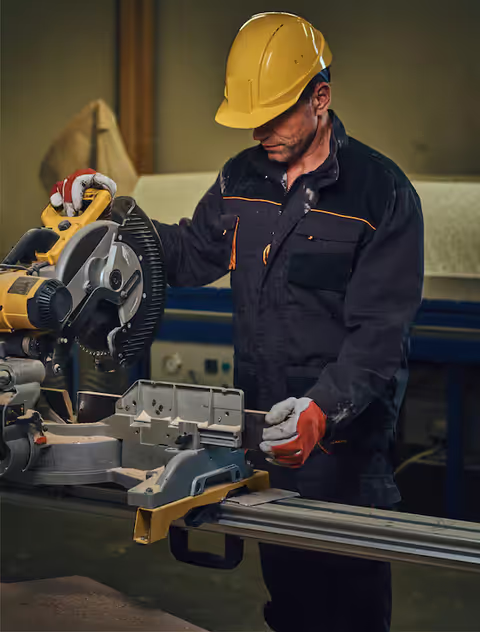
Power tools improve efficiency through electric, pneumatic, or hydraulic systems.
Examples include:
Angle grinders
Impact wrenches
Rotary hammers
Circular saws
Die grinders
Cordless industrial drills
These tools combine mechanical engineering with electrical components.
Measuring and Precision Tools
Precision measurement ensures manufacturing accuracy.
Common tools include:
Calipers
Micrometers
Dial indicators
Height gauges
Torque measuring devices
Laser measurement tools
Accuracy is a critical requirement during manufacturing.
Specialized Industrial Tools
Some industries require application-specific tooling, including:
Mold tools
Die tools
Press tools
CNC tooling
Aerospace cutting tools
Welding fixtures
These tools are often custom manufactured.
The Industrial Tools Manufacturing Process
Modern manufacturing follows a structured workflow to ensure consistency and quality.
1. Product Design and Engineering
Every tool begins with engineering design. Manufacturers create digital models using computer-aided design software.
Design engineers consider:
Tool function.
Material compatibility.
Strength requirements.
Precision tolerances.
Ergonomics.
Manufacturing feasibility.
Prototype testing helps validate performance before production begins.
2. Material Selection
Material selection directly affects durability and performance.
Common materials include:
| Material | Common Use |
|---|---|
| High-speed steel | Cutting and drilling tools |
| Carbon steel | Hand tools and general-purpose tools |
| Tool steel | Industrial dies and punches |
| Tungsten carbide | High-precision cutting tools |
| Alloy steel | Heavy-duty industrial tools |
| Stainless steel | Corrosion-resistant tools |
Material properties such as hardness, toughness, corrosion resistance, and heat resistance determine tool performance.
3. Raw Material Processing
The selected material undergoes preparation before shaping.
Processing methods include:
Forging.
Casting.
Rolling.
Extrusion.
Metal bar preparation.
These methods create blanks for machining.
4. Machining and Shaping
Precision machining forms the tool into its final geometry.
Common machining techniques include:
CNC milling.
CNC turning.
Grinding.
Drilling.
Broaching.
EDM machining for complex shapes.
Computer-controlled machines improve consistency and reduce manufacturing errors.
5. Heat Treatment
Heat treatment enhances mechanical properties.
Common heat treatment methods include:
Hardening.
Tempering.
Annealing.
Case hardening.
Induction hardening.
Proper heat treatment increases wear resistance while maintaining structural strength.
6. Surface Finishing
Surface finishing improves appearance and functionality.
Processes include:
Polishing.
Sandblasting.
Electroplating.
Powder coating.
Oxide coating.
Anti-corrosion treatments.
Special coatings may reduce friction and extend tool life.
7. Inspection and Quality Testing
Every finished tool undergoes quality verification.
Testing includes:
Dimensional inspection.
Hardness testing.
Strength testing.
Surface finish inspection.
Functional performance testing.
Durability testing.
Quality control ensures each tool meets manufacturing specifications.
Technologies Used in Modern Industrial Tools Manufacturing
Technology has significantly improved production efficiency and tool quality.
CNC Manufacturing
Computer Numerical Control machines produce highly accurate tools with minimal manual intervention.
Benefits include:
Repeatable precision.
Faster production.
Reduced waste.
Complex tool geometries.
Automation and Robotics
Robotic systems automate repetitive production tasks.
Applications include:
Material handling.
Tool assembly.
Welding.
Inspection.
Packaging.
Automation improves consistency while reducing production time.
Additive Manufacturing
Industrial tool manufacturers increasingly use metal 3D printing for prototypes and specialized tooling.
Benefits include:
Rapid prototyping.
Lightweight tool design.
Reduced material waste.
Faster product development.
Smart Manufacturing
Connected manufacturing systems monitor production in real time.
Features include:
Machine monitoring.
Predictive maintenance.
Production analytics.
Digital quality tracking.
Automated process optimization.
Smart factories improve operational efficiency.
Industries That Depend on Industrial Tools
Industrial tools are essential across many sectors.
Automotive Manufacturing
Automotive production requires precision tooling for machining, assembly, welding, and inspection.
Applications include:
Engine manufacturing.
Body assembly.
Brake systems.
Transmission components.
Construction Industry
Construction professionals rely on durable tools for drilling, cutting, fastening, and demolition.
Aerospace Industry
Aerospace manufacturing requires extremely precise tools capable of working with advanced alloys and composite materials.
Electronics Manufacturing
Small precision tools help assemble electronic devices, circuit boards, and delicate components.
Oil, Gas, and Energy
Heavy-duty industrial tools operate in demanding environments involving high pressure and extreme temperatures.
Quality Standards in Industrial Tools Manufacturing
Quality standards help ensure reliability and safety.
Manufacturers typically focus on:
Dimensional accuracy.
Material consistency.
Mechanical strength.
Heat resistance.
Wear resistance.
Corrosion protection.
Standardized testing procedures help maintain consistent product quality throughout production.
Documentation and traceability are also important in industrial manufacturing environments.
Sustainability in Industrial Tools Manufacturing
Sustainability has become an important focus across manufacturing industries.
Efficient Material Usage
Manufacturers reduce waste through:
Precision machining.
Material recycling.
Scrap metal recovery.
Optimized cutting paths.
Energy-Efficient Manufacturing
Modern facilities invest in:
Energy-efficient machinery.
Automated production scheduling.
Improved furnace efficiency.
Smart energy monitoring.
Eco-Friendly Surface Treatments
Many manufacturers are adopting safer finishing processes that reduce hazardous chemical usage while maintaining product performance.
Circular Manufacturing Practices
Industrial tools can often be refurbished, reconditioned, or recycled, extending product life and reducing waste generation.
Challenges in Industrial Tools Manufacturing
Despite technological advances, manufacturers face several ongoing challenges.
Maintaining Precision
As industries demand tighter tolerances, manufacturers must continuously improve machining accuracy and inspection systems.
Rising Material Costs
Changes in global material availability can affect production planning and inventory management.
Skilled Workforce Requirements
Operating CNC machines, robotics, and advanced inspection equipment requires specialized technical skills.
Equipment Maintenance
Manufacturing facilities rely on preventive maintenance to avoid production interruptions and maintain consistent quality.
Adapting to Industry 4.0
Integrating digital systems with traditional manufacturing processes requires investment in technology and workforce training.
Recent Trends in Industrial Tools Manufacturing
The industry has experienced several important developments over the past year.
Greater Adoption of AI in Manufacturing
Artificial intelligence is helping manufacturers improve quality inspection, predictive maintenance, and production planning through data analysis.
Expansion of Smart Factory Technologies
Connected machines, sensors, and industrial internet platforms allow manufacturers to monitor production performance in real time.
Growth in Sustainable Manufacturing
Manufacturers continue investing in recyclable materials, lower-emission production methods, and energy-efficient operations.
Increased Demand for Precision Tooling
Industries such as electric vehicles, renewable energy, aerospace, and semiconductor manufacturing require highly specialized precision tools.
Digital Twin Technology
Digital twins allow manufacturers to simulate tool performance and production processes before physical manufacturing begins, reducing development time and improving efficiency.
How to Identify High-Quality Industrial Tools
Choosing industrial tools involves evaluating several practical factors rather than appearance alone.
Important considerations include:
Material quality.
Manufacturing precision.
Heat treatment quality.
Surface finishing.
Durability testing.
Intended industrial application.
Compliance with relevant manufacturing standards.
Tools designed for professional industrial environments typically prioritize long-term reliability and consistent performance.
Future of Industrial Tools Manufacturing
Industrial tools manufacturing is expected to continue evolving through automation, advanced materials, and intelligent production systems.
Future developments are likely to include:
AI-assisted manufacturing optimization.
More advanced robotic production lines.
Increased use of lightweight high-strength materials.
Greater adoption of digital quality inspection.
Sustainable production processes with reduced waste.
Custom industrial tooling produced through additive manufacturing.
These innovations aim to improve productivity, precision, and environmental responsibility across manufacturing industries.
Best Practices for Industrial Tool Manufacturing Facilities
Successful manufacturing operations generally follow consistent best practices.
These include:
Implementing rigorous quality control procedures.
Maintaining CNC equipment regularly.
Using traceable material sourcing systems.
Training employees on advanced manufacturing technologies.
Monitoring production data continuously.
Following workplace safety and maintenance protocols.
A structured manufacturing process helps improve product consistency while reducing defects and downtime.
Conclusion
Industrial tools manufacturing is a foundation of modern industrial production. Every stage—from engineering design and material selection to machining, heat treatment, finishing, and quality inspection—contributes to producing tools that meet demanding industrial applications.
As manufacturing technology advances, the industry continues adopting automation, artificial intelligence, smart factory systems, and sustainable production methods. These improvements help manufacturers produce stronger, more precise, and longer-lasting industrial tools while improving efficiency and reducing environmental impact.
Understanding industrial tools manufacturing provides valuable insight into how essential tools are developed and why quality manufacturing practices remain critical for industries ranging from construction and automotive production to aerospace, electronics, energy, and advanced engineering.