Jump to a Chapter

Industrial Engineering Systems: A Complete Guide to Modern Industrial Operations

Industrial Engineering Systems: A Complete Guide to Modern Industrial Operations

Industrial engineering systems are the foundation of modern manufacturing and production environments. They combine people, machines, materials, information, and technology into an organized framework that helps industries operate more efficiently. Whether a factory produces automobiles, electronics, pharmaceuticals, food products, or industrial equipment, industrial engineering systems help ensure that every process works together in a structured and productive way.

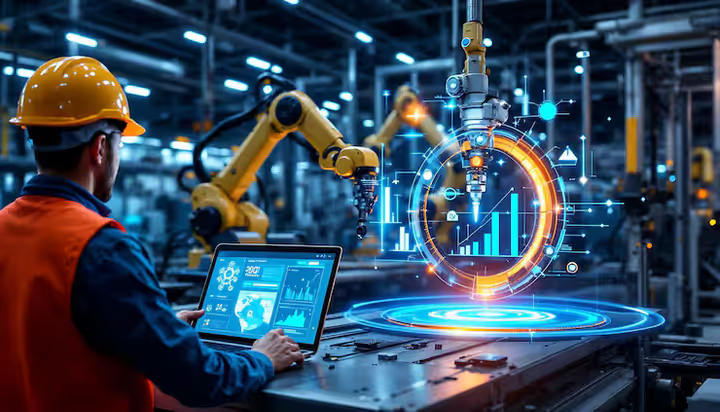
As industries continue adopting automation, artificial intelligence, digital monitoring, and connected technologies, industrial engineering systems have become more intelligent and data-driven. Organizations are no longer focused only on producing goods quickly. They also aim to improve quality, reduce waste, optimize resources, enhance worker safety, and respond faster to changing customer demands.

Understanding industrial engineering systems is valuable for students, engineers, manufacturing professionals, business owners, and anyone interested in how modern industrial operations function. This guide explains the concept, components, applications, benefits, challenges, and future developments in a simple and practical way.

What Are Industrial Engineering Systems?

Industrial engineering systems are integrated methods and technologies used to design, manage, improve, and optimize industrial operations. Instead of looking at a single machine or production step, they examine the complete production system and identify ways to improve performance across the entire workflow.

An industrial engineering system connects multiple operational elements into one coordinated process. These elements include production planning, inventory management, quality control, logistics, maintenance, workforce management, automation systems, and performance monitoring.

The goal is to create a production environment where resources are used effectively while maintaining consistent quality and minimizing unnecessary delays or waste.

Modern industrial engineering systems rely on data collected from machines, sensors, enterprise software, and production equipment to support better decision-making and continuous improvement.

Why Industrial Engineering Systems Matter Today

Manufacturing industries operate in a highly competitive environment where efficiency and reliability directly affect productivity. Industrial engineering systems help organizations meet these expectations by improving operational performance without compromising quality.

As customer demand changes more rapidly, factories need flexible production systems capable of adjusting schedules, materials, and resources efficiently. Industrial engineering systems provide this flexibility by coordinating production activities across departments.

These systems also help industries reduce downtime, improve equipment utilization, manage supply chains more accurately, and maintain consistent production standards across multiple facilities.

In sectors such as healthcare manufacturing, automotive production, renewable energy equipment, electronics, aerospace, textiles, and food processing, industrial engineering systems play an essential role in maintaining operational consistency and meeting regulatory requirements.

Core Components of Industrial Engineering Systems

Industrial engineering systems consist of several interconnected components that work together throughout the production lifecycle.

Production Planning

Production planning determines what products should be manufactured, when production should begin, how resources should be allocated, and how schedules should be organized. Effective planning reduces bottlenecks and helps maintain steady production flow.

Process Design

Process design focuses on creating efficient workflows for manufacturing products. Engineers study each production stage to eliminate unnecessary steps and improve resource utilization.

Quality Management

Quality management systems monitor production standards throughout manufacturing. Inspection procedures, statistical analysis, testing methods, and continuous improvement practices help maintain consistent product quality.

Supply Chain Coordination

Industrial engineering systems coordinate suppliers, inventory, transportation, warehousing, and production schedules to ensure materials arrive when needed without excessive inventory buildup.

Maintenance Management

Maintenance systems monitor equipment condition and schedule preventive maintenance before failures occur. Predictive maintenance has become increasingly common through sensor-based monitoring.

Workforce Optimization

Workforce planning ensures employees, equipment operators, supervisors, and maintenance teams are assigned efficiently based on production needs and operational priorities.

How Industrial Engineering Systems Work

Industrial engineering systems operate by collecting information from different production activities and using that information to improve operational decisions.

The process usually begins with forecasting production demand. Materials are ordered based on projected requirements, production schedules are created, machines are assigned tasks, and workers receive operational instructions.

During manufacturing, sensors, software platforms, and monitoring systems collect real-time production data. This information includes machine performance, production speed, quality measurements, equipment status, inventory levels, and operational efficiency.

Industrial engineers analyze this information to identify delays, equipment issues, quality variations, or opportunities for process improvement. Continuous monitoring allows organizations to respond quickly before small issues become larger operational problems.

This integrated approach helps maintain smooth production while reducing interruptions and improving resource utilization.

Technologies Used in Modern Industrial Engineering Systems

Industrial engineering systems have evolved significantly through digital transformation. Several technologies now support smarter manufacturing environments.

Industrial Automation

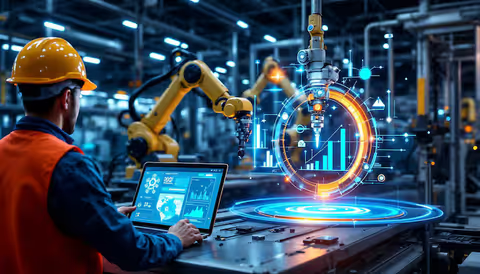
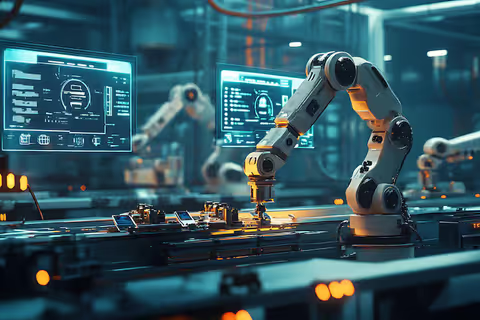
Automation systems perform repetitive production tasks with greater precision and consistency. Automated assembly lines, robotic systems, and programmable controllers improve productivity while reducing manual intervention.

Internet of Things in Manufacturing

Connected sensors collect operational data from machines, conveyors, motors, pumps, and production equipment. This data provides real-time visibility into factory performance.

Artificial Intelligence and Analytics

AI analyzes production data to detect patterns, predict equipment failures, optimize scheduling, and improve quality inspection processes.

Digital Twin Technology

Digital twins create virtual models of production systems, allowing engineers to simulate changes before implementing them in physical operations.

Manufacturing Execution Systems

Manufacturing Execution Systems coordinate production activities between factory equipment and enterprise management software, providing visibility into production status and operational performance.

Enterprise Resource Planning Integration

ERP systems connect manufacturing, inventory, purchasing, finance, human resources, and logistics into one centralized management platform.

Applications Across Different Industries

Industrial engineering systems are widely used across manufacturing and industrial sectors because every industry requires efficient production processes.

In automotive manufacturing, industrial engineering systems coordinate assembly lines, robotic welding, painting operations, component logistics, and quality inspection.

Electronics manufacturers use these systems for precision assembly, component tracking, clean-room operations, testing procedures, and inventory management.

Food and beverage industries rely on industrial engineering systems for packaging automation, production scheduling, hygiene monitoring, temperature control, and distribution planning.

Pharmaceutical manufacturers use integrated systems for batch production, quality validation, compliance monitoring, traceability, and controlled manufacturing environments.

Textile industries apply industrial engineering systems to spinning, weaving, dyeing, finishing, quality inspection, and warehouse operations.

Renewable energy equipment manufacturers use these systems for producing solar panels, batteries, wind turbine components, and electrical equipment with strict quality standards.

Benefits of Industrial Engineering Systems

Industrial engineering systems provide operational improvements across multiple areas of manufacturing.

One major benefit is increased productivity. Efficient workflows reduce idle time and improve machine utilization, allowing factories to produce more with existing resources.

Another important advantage is improved product quality. Continuous monitoring and standardized production processes reduce defects and improve consistency.

Resource optimization is another significant benefit. Materials, labor, energy, and equipment are managed more effectively, reducing unnecessary consumption and operational waste.

Industrial engineering systems also improve production visibility. Managers receive real-time information about production progress, inventory levels, equipment performance, and maintenance requirements.

Safety improvements are another valuable outcome. Organized workflows, automated monitoring, and predictive maintenance reduce operational risks and improve workplace safety.

Finally, continuous improvement becomes easier because operational data provides measurable insights into production performance over time.

Industrial Engineering Systems and Lean Manufacturing

Lean manufacturing and industrial engineering systems often work together because both focus on improving efficiency and reducing waste.

Industrial engineers identify activities that do not add value to the production process. These activities may include unnecessary transportation, waiting time, excess inventory, overproduction, unnecessary motion, or repeated processing.

Lean principles encourage continuous improvement through standardized workflows and employee involvement in identifying operational improvements.

Industrial engineering systems support lean manufacturing by measuring production performance, identifying bottlenecks, analyzing workflows, and implementing improvements based on operational data rather than assumptions.

This combination helps organizations improve efficiency while maintaining product quality and operational stability.

Common Challenges in Industrial Engineering Systems

Although industrial engineering systems provide many advantages, implementation can present several challenges.

One challenge is integrating older equipment with modern digital technologies. Many factories still operate legacy machines that require additional hardware or software for connectivity.

Another challenge involves workforce training. Employees need skills to operate digital systems, automation equipment, and production monitoring software effectively.

Data management also becomes increasingly important as connected manufacturing systems generate large volumes of operational information. Organizations need reliable methods for collecting, organizing, and analyzing this data.

Supply chain disruptions may also affect production planning. Industrial engineering systems must adapt quickly when material availability changes unexpectedly.

Cybersecurity has become another important consideration because connected industrial equipment requires secure communication and protected operational networks.

Despite these challenges, careful planning and gradual implementation help organizations modernize industrial operations successfully.

Recent Trends in Industrial Engineering Systems

Industrial engineering systems have experienced significant technological development during the past year.

Factories continue expanding the use of AI-assisted production monitoring for predictive maintenance and production optimization. Machine learning models are increasingly used to identify equipment issues before failures occur.

Smart factories continue adopting connected sensors that provide continuous visibility into production equipment and environmental conditions.

Digital twins are becoming more widely used for production planning, equipment simulation, and factory layout optimization before physical implementation.

Energy efficiency has become a stronger focus as manufacturers monitor electricity consumption, machine efficiency, and production energy usage in real time.

Collaborative robots continue expanding in manufacturing environments where humans and automated systems work together safely during assembly and inspection processes.

Sustainability reporting has also become more integrated into industrial engineering systems through monitoring of material usage, waste generation, emissions, and resource efficiency.

Best Practices for Effective Industrial Engineering Systems

Successful industrial engineering systems begin with understanding the complete production process before introducing improvements.

Organizations benefit from collecting accurate operational data and using consistent performance metrics across departments.

Standardizing production procedures helps maintain quality while reducing operational variation between production shifts or facilities.

Preventive and predictive maintenance improve equipment reliability and reduce unexpected downtime.

Continuous employee training helps workers adapt to automation technologies, digital monitoring tools, and evolving manufacturing practices.

Cross-functional collaboration between engineering, production, maintenance, logistics, and quality teams improves communication and supports more effective decision-making.

Regular performance reviews help identify opportunities for continuous improvement based on measurable production results.

The Future of Industrial Engineering Systems

Industrial engineering systems are expected to become increasingly intelligent, connected, and adaptable over the coming years.

Artificial intelligence will continue supporting production scheduling, quality inspection, demand forecasting, and maintenance planning with greater accuracy.

Autonomous manufacturing systems may perform more operational adjustments automatically based on real-time production conditions.

Cloud-based industrial platforms will improve collaboration between multiple manufacturing facilities while providing centralized operational visibility.

Sustainable manufacturing will become more deeply integrated into industrial engineering systems through energy monitoring, waste reduction, recycling coordination, and resource optimization.

Human-machine collaboration will continue evolving as automation handles repetitive tasks while workers focus on supervision, analysis, maintenance, and process improvement.

The future emphasizes flexible manufacturing systems capable of responding quickly to changing customer demands without sacrificing efficiency or product quality.

Frequently Asked Questions

What is the main purpose of industrial engineering systems?

Industrial engineering systems help design, manage, and optimize manufacturing and industrial operations by improving productivity, quality, resource utilization, and operational efficiency.

Which industries use industrial engineering systems?

They are widely used in automotive, electronics, pharmaceuticals, food processing, textiles, aerospace, renewable energy, logistics, chemicals, and heavy manufacturing industries.

How do industrial engineering systems improve productivity?

They improve production planning, reduce bottlenecks, optimize workflows, monitor equipment performance, and support continuous process improvement using operational data.

Are industrial engineering systems only for large factories?

No. Small and medium-sized manufacturing businesses also use industrial engineering systems to improve inventory management, production scheduling, quality control, and maintenance planning.

What technologies are commonly used in industrial engineering systems?

Common technologies include industrial automation, IoT sensors, manufacturing execution systems, enterprise resource planning software, artificial intelligence, digital twins, robotics, and predictive analytics.

Conclusion

Industrial engineering systems have become an essential part of modern manufacturing by connecting production planning, automation, quality management, maintenance, logistics, and workforce coordination into one integrated operational framework. Rather than focusing on individual machines or isolated processes, these systems optimize the complete manufacturing environment to improve efficiency, consistency, and reliability.

As industries continue embracing digital transformation, industrial engineering systems are evolving through AI, connected sensors, predictive maintenance, and smart factory technologies. These developments help organizations respond more effectively to changing production demands while improving quality, sustainability, and operational visibility.

Understanding industrial engineering systems provides valuable insight into how modern industries design efficient production processes, manage resources responsibly, and continuously improve performance in an increasingly connected industrial world.

author-image

Zephyra

I am a creative and detail-oriented Content Writer passionate about producing clear, engaging, and informative content for digital audiences.

September 17, 2026 . 9 min read