Industrial Painting Robots: Complete Guide to Automated Industrial Coating Systems
Industrial painting robots have become an important part of modern manufacturing because they help apply coatings with greater consistency, speed, and precision than many manual methods. From automotive factories to furniture production and heavy machinery manufacturing, these robotic systems are changing how industries approach painting and surface finishing.
As manufacturing continues to adopt automation, painting robots are no longer limited to large production facilities. Businesses across different industries are exploring automated coating systems to improve product quality, reduce material waste, and create safer working environments. Understanding how industrial painting robots operate and where they are used helps explain why they have become a significant technology in today's production processes.
This guide explains industrial painting robots in a simple and practical way, covering their working principles, importance, recent developments, applications, and future trends.
Understanding Industrial Painting Robots
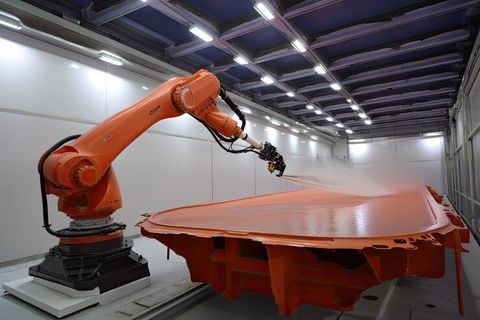
Industrial painting robots are programmable robotic machines designed to apply paint, coatings, primers, varnishes, or protective finishes onto products and surfaces. They automate repetitive painting tasks while maintaining consistent coverage and finish quality across large production volumes.
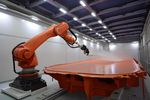
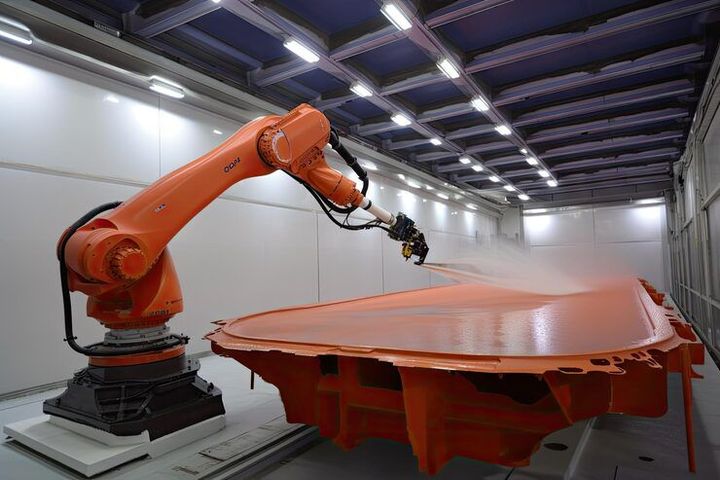
These robots typically operate inside specially designed paint booths where environmental conditions such as airflow, temperature, and humidity are controlled. The robotic arm follows pre-programmed paths that ensure even application across complex shapes and surfaces.
Unlike manual painting, robotic systems can repeat the same motion thousands of times with minimal variation, making them suitable for industries where appearance, durability, and coating thickness must remain consistent.
Industrial painting robots are commonly integrated into automated production lines, working alongside conveyors, sensors, inspection systems, and other manufacturing equipment.
Why Industrial Painting Robots Matter Today
The demand for consistent product quality has increased across manufacturing industries. Customers expect smooth finishes, durable coatings, and visually appealing products, while manufacturers seek greater efficiency and reduced production waste.
Industrial painting robots help address these requirements by improving precision and repeatability during the coating process.
Another reason these robots matter is workplace safety. Many industrial paints contain chemicals, solvents, or fine particles that require controlled handling. Robotic systems reduce direct human exposure to these materials by performing painting operations inside enclosed environments.
Automation also supports manufacturers dealing with higher production volumes. Robots can operate for extended periods with consistent performance, making them useful for continuous manufacturing processes.
As industries focus on sustainability, painting robots also contribute by optimizing paint usage and minimizing overspray, reducing both waste and environmental impact.
How Industrial Painting Robots Work
An industrial painting robot combines robotic motion, paint delivery technology, and software programming to complete coating tasks accurately.
The process usually begins when sensors or conveyor systems position a product inside the painting area. The robot receives information about the object's size, orientation, and painting requirements.
Its robotic arm moves along programmed paths while a spray gun applies the coating evenly across the surface. Advanced robots automatically adjust spray angle, distance, speed, and paint flow based on the product geometry.
Modern systems often include vision cameras or laser scanners that identify object positions and compensate for slight variations in placement.
After painting, products move to drying or curing systems before quality inspection.
The complete workflow is designed to deliver uniform coating thickness while minimizing paint waste.
Main Components of an Industrial Painting Robot System
A painting robot system includes several technologies working together throughout the coating process.
The robotic arm provides flexible movement across multiple axes, allowing it to reach curved, angled, and hard-to-access surfaces.
The spray applicator controls how paint is atomized and applied. Different applicators are used depending on the coating material and finish requirements.
The paint supply system manages paint pressure, mixing, filtration, and delivery to the spray gun.
Controllers and software coordinate robot movement, spraying patterns, safety functions, and production schedules.
Sensors monitor robot position, paint flow, booth conditions, and equipment performance to maintain consistent results.
Together, these components create an automated painting process that can be customized for different manufacturing environments.
Types of Industrial Painting Robots
Industrial painting robots are available in different configurations depending on production requirements.
Articulated robots are the most common because their multiple joints allow flexible movement around complex products such as vehicle bodies and machinery components.
Cartesian painting robots move along straight X, Y, and Z axes, making them suitable for flat or rectangular surfaces requiring precise linear motion.
Collaborative painting robots are designed to work safely alongside human operators in controlled environments where partial automation is needed.
Gantry painting systems operate above large products such as industrial equipment, containers, or structural components.
Each type is selected based on workspace size, object geometry, production speed, and coating requirements.
Industries That Use Industrial Painting Robots
Industrial painting robots serve many manufacturing sectors where protective or decorative coatings are required.
Automotive Manufacturing
Vehicle bodies, doors, bumpers, wheels, and other automotive components are painted using robotic systems to achieve consistent finishes and color matching.
Aerospace Industry
Aircraft components require highly controlled coating thickness for corrosion protection and aerodynamic performance.
Furniture Manufacturing
Wooden furniture, cabinets, panels, and decorative products receive uniform paint or varnish coatings through automated systems.
Metal Fabrication
Steel structures, industrial equipment, pipes, and fabricated metal parts often require protective coatings against corrosion and environmental exposure.
Consumer Electronics
Electronic device enclosures, appliances, and metal housings benefit from precise decorative coatings and protective finishes.
Heavy Equipment Manufacturing
Construction machinery, agricultural equipment, and industrial vehicles use robotic painting for durable protective coatings.
Benefits of Industrial Painting Robots
Industrial painting robots provide several operational advantages across manufacturing environments.
One major benefit is coating consistency. Automated systems apply uniform paint thickness, reducing visual defects and improving finish quality.
Paint efficiency also improves because robots control spray patterns and minimize overspray, leading to better material utilization.
Production speed increases as robots maintain consistent cycle times without fatigue, making them suitable for large-scale manufacturing.
Safety improves by limiting worker exposure to hazardous paint fumes, solvents, and repetitive spraying tasks.
Quality control becomes easier because programmable movements reduce variation between products produced on different shifts.
Automation also helps manufacturers maintain repeatable standards for products requiring strict coating specifications.
Challenges and Limitations
Although industrial painting robots provide many advantages, they also present operational challenges that manufacturers must manage.
Initial installation requires careful planning, including paint booth design, robot programming, safety systems, and integration with production equipment.
Programming complex objects may require advanced path planning to ensure complete surface coverage.
Maintenance is necessary to keep spray guns, pumps, filters, sensors, and robotic joints operating efficiently.
Some products with highly irregular shapes may require additional programming adjustments or manual finishing.
Facilities adopting robotic painting systems also need trained personnel capable of monitoring equipment and optimizing robotic programs.
Understanding these challenges helps manufacturers implement automation more effectively.
Industrial Painting Robots and Surface Quality
Surface quality depends on more than the robot itself. The entire painting process influences the final result.
Proper surface preparation removes dust, oil, rust, or contaminants before painting begins.
Robotic systems maintain consistent spray distance and movement speed, reducing uneven coating buildup.
Controlled booth environments help prevent dust contamination and improve finish appearance.
Automated monitoring systems can detect paint pressure changes or nozzle issues before they affect product quality.
As a result, robotic painting contributes to smoother finishes and more predictable coating performance across production batches.
Recent Developments in Industrial Painting Robots
During the past year, industrial painting robotics has continued evolving with greater intelligence and automation.
Manufacturers are increasingly adopting AI-assisted path optimization, allowing robots to generate efficient painting routes for complex surfaces with less manual programming.
Vision-guided robotic systems have improved object recognition, helping robots identify product positions more accurately even when items are placed slightly differently on conveyors.
Digital twin technology has become more common in robotic painting environments. Engineers can simulate painting operations virtually before deploying programs on physical robots, reducing setup time and testing costs.
Energy-efficient paint application systems have also received attention as industries seek lower emissions and reduced material consumption.
Another trend is predictive maintenance, where sensors continuously monitor robotic components and identify maintenance needs before equipment failures occur.
These developments reflect the broader shift toward smarter and more connected manufacturing systems.
Industrial Painting Robots and Smart Manufacturing
Industrial painting robots play an important role in Industry 4.0 manufacturing environments.
Connected robots exchange information with production management systems, allowing factories to monitor painting operations in real time.
Data collected from sensors helps manufacturers track paint consumption, equipment performance, production efficiency, and maintenance schedules.
Cloud-based monitoring platforms allow engineers to analyze production trends across multiple manufacturing locations.
Integration with automated inspection systems enables painted products to move directly into quality verification without manual handling.
This level of connectivity supports better decision-making and continuous production improvement.
Environmental and Workplace Considerations
Modern manufacturing increasingly focuses on reducing environmental impact while maintaining productivity.
Industrial painting robots contribute by controlling overspray and improving paint transfer efficiency, reducing unnecessary coating waste.
Automated systems also support low-emission coating processes and efficient ventilation management inside paint booths.
Because robots perform painting tasks inside enclosed environments, workplace exposure to airborne paint particles and chemical vapors is reduced.
Many facilities combine robotic painting with filtration and recovery systems that help capture excess paint particles before they enter the surrounding environment.
These improvements support safer and cleaner manufacturing operations.
Choosing the Right Industrial Painting Robot
Selecting an industrial painting robot depends on production goals rather than a single technology choice.
Manufacturers typically evaluate product size, coating material, production volume, surface complexity, and required finish quality before choosing a robotic configuration.
Workspace layout also influences robot selection because painting booths must accommodate robot movement, conveyors, ventilation, and safety equipment.
Software compatibility, maintenance requirements, and integration with existing automation systems are additional considerations during implementation.
A well-planned robotic painting system balances flexibility, accuracy, and production efficiency according to manufacturing needs.
The Future of Industrial Painting Robots
Industrial painting robots are expected to become even more intelligent, adaptable, and connected as manufacturing automation advances.
Artificial intelligence will continue improving automatic path generation and coating optimization for increasingly complex products.
Machine vision systems are likely to provide better real-time surface analysis, allowing robots to adjust painting parameters while operating.
Collaborative robotic solutions may expand opportunities for flexible manufacturing environments where humans and robots share production tasks safely.
Sustainability will remain a major focus, encouraging technologies that reduce paint waste, energy consumption, and environmental emissions.
As digital manufacturing grows, painting robots will increasingly operate as part of fully connected production ecosystems that combine robotics, sensors, analytics, and automated quality inspection.
Conclusion
Industrial painting robots have become an essential technology in modern manufacturing because they improve coating consistency, production efficiency, workplace safety, and material utilization. Their ability to perform repetitive painting tasks with precision makes them valuable across industries including automotive, aerospace, furniture, electronics, metal fabrication, and heavy equipment manufacturing.
Recent advances in artificial intelligence, machine vision, predictive maintenance, and digital twin technology are making robotic painting systems smarter and easier to integrate into connected manufacturing environments. While successful implementation requires planning, programming, and maintenance, automated painting continues to support higher-quality finishes and more efficient production processes.
As manufacturing evolves toward intelligent automation and sustainable production, industrial painting robots are expected to remain a key part of advanced industrial coating systems, helping industries deliver reliable surface finishes with greater precision and consistency.