Industrial Robotics Applications: A Complete Guide to Modern Automation
Industrial robotics has become one of the most important technologies shaping modern industries. From automobile assembly lines to food packaging facilities, robots are helping organizations improve efficiency, maintain quality, and handle repetitive or complex tasks with greater consistency. As automation technologies continue to evolve, industrial robots are no longer limited to large factories. They are now used across manufacturing, healthcare, logistics, electronics, agriculture, and many other sectors.
Understanding industrial robotics applications is valuable for students, professionals, business owners, and anyone interested in modern technology. Robots are designed to assist people rather than simply replace human work. They often perform tasks that require precision, speed, or operation in environments that may be difficult or unsafe for people.
This guide explains what industrial robotics applications are, why they matter, where they are used, recent developments, regulations, useful tools, frequently asked questions, and what the future of industrial robotics looks like.
What Are Industrial Robotics Applications?
Industrial robotics applications refer to the different tasks and processes where programmable robotic systems are used in industrial environments. These robots are designed to perform physical operations automatically or with minimal human supervision. They can move materials, assemble products, inspect components, weld metals, paint surfaces, and perform many other specialized activities.
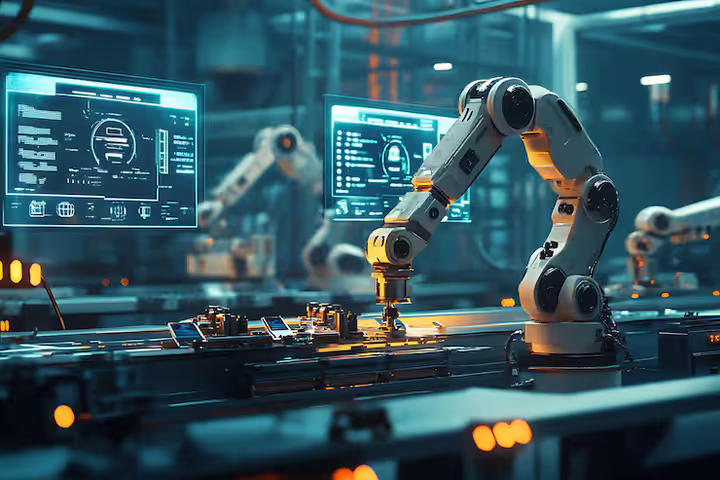
Industrial robots usually consist of robotic arms, sensors, controllers, actuators, and software that allows them to follow programmed instructions. Some robots operate independently, while others work alongside people in collaborative workspaces.
Unlike traditional machines built for a single task, many modern industrial robots can be reprogrammed for different operations. This flexibility makes them suitable for changing production requirements and evolving manufacturing processes.
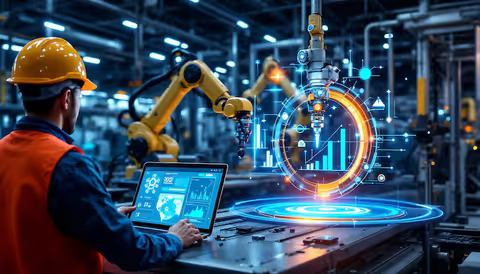
Industrial robotics combines mechanical engineering, electronics, artificial intelligence, machine vision, and software automation to create intelligent production systems capable of adapting to different industrial needs.
Why Industrial Robotics Applications Matter Today
Industrial robotics has become increasingly important because industries face growing demands for higher productivity, consistent quality, and safer working environments. As production volumes increase and supply chains become more complex, automation helps organizations maintain reliable operations.
Robots reduce repetitive manual work by handling tasks that require continuous accuracy. They can operate for extended periods without experiencing fatigue, making them useful in environments where production runs continuously.
Safety is another important reason robotics applications are expanding. Robots can perform hazardous tasks such as handling chemicals, working with extreme temperatures, lifting heavy materials, or operating in confined spaces. This reduces workplace risks while allowing employees to focus on monitoring, maintenance, and decision-making responsibilities.
Industrial robotics also supports product quality by minimizing variations in manufacturing processes. Precision movements help maintain consistent dimensions, accurate assembly, and reliable inspection standards across large production batches.
Common Types of Industrial Robots
Different industries use different types of robots depending on production needs. Each robot design is suited for specific applications and movement requirements.
Articulated robots are among the most widely used industrial robots. They feature multiple rotating joints that allow flexible movement similar to a human arm. These robots are commonly used for welding, painting, assembly, and material handling.
SCARA robots are designed for high-speed horizontal movements. They are widely used in electronics manufacturing, packaging, and pick-and-place operations where precision and speed are important.
Cartesian robots move along straight X, Y, and Z axes. They are useful for CNC machine loading, 3D printing, palletizing, and automated material transfer.
Delta robots use lightweight arms connected to a central base. Their fast movement makes them suitable for sorting, packaging, pharmaceutical production, and food processing.
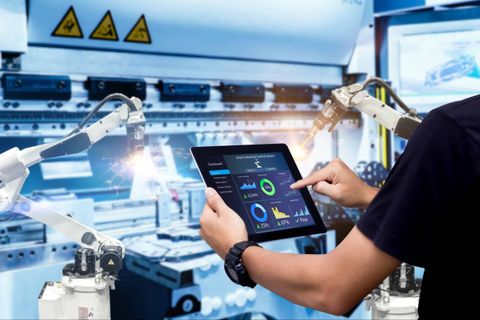
Collaborative robots, often called cobots, are designed to safely work alongside human operators. They include sensors that detect nearby movement and adjust operations to improve workplace safety.
Each robot type supports different industrial robotics applications depending on speed, payload capacity, workspace size, and precision requirements.
Industrial Robotics Applications Across Different Industries
Industrial robots are now used in many industries beyond traditional manufacturing. Their applications continue expanding as automation technologies become more accessible.
Manufacturing and Assembly
Manufacturing remains the largest application area for industrial robotics. Robots assemble components, tighten fasteners, insert electronic parts, and perform repetitive production tasks with consistent accuracy.
Automotive manufacturing uses robotic systems extensively for welding vehicle frames, painting body panels, installing components, and moving heavy assemblies through production lines.
Electronics manufacturing relies on robots for handling delicate circuit boards, assembling mobile devices, soldering components, and performing precision inspection.
Material Handling and Warehousing
Industrial robotics applications play a major role in warehouses and distribution centers. Robots transport goods between storage locations, sort packages, load pallets, and prepare shipments.
Automated guided vehicles and autonomous mobile robots help move inventory efficiently across warehouses while reducing manual transportation work.
Robotic palletizing systems stack products into organized loads before shipping, improving speed and consistency during logistics operations.
Welding and Metal Fabrication
Robotic welding is widely used because it provides consistent weld quality and reduces exposure to heat and sparks.
Industrial robots perform spot welding, arc welding, laser welding, and metal cutting operations in automotive, aerospace, construction, and heavy equipment manufacturing.
Robotic fabrication systems also assist with grinding, polishing, drilling, and machining operations where precision is essential.
Food and Beverage Industry
Food production requires hygiene and consistency, making robotics increasingly valuable.
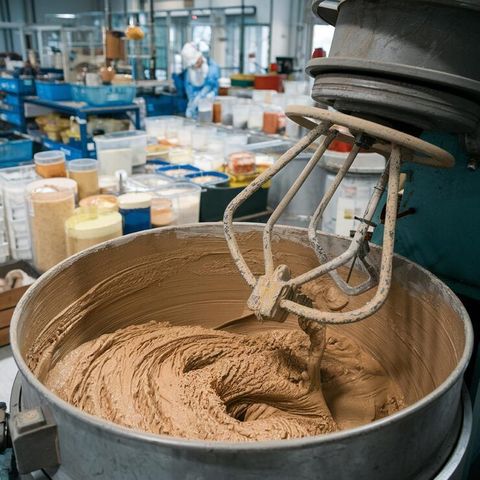
Robots package food products, sort fruits and vegetables, decorate bakery products, bottle beverages, and inspect packaging quality. Specialized robots operate in clean environments while meeting food safety standards.
Automation also helps maintain product consistency during large-scale food manufacturing.
Pharmaceutical and Healthcare Manufacturing
Industrial robotics applications support pharmaceutical production through precise dispensing, packaging, labeling, inspection, and sterile handling processes.
Robotic systems help manufacture medical devices, laboratory equipment, and healthcare products while maintaining controlled production environments.
In laboratories, robots assist with sample preparation, testing workflows, and repetitive research procedures.
Logistics and Supply Chain Operations
Distribution centers increasingly depend on robotics to improve inventory movement and order fulfillment.
Robots identify products using machine vision, transport containers, sort parcels, and optimize warehouse storage locations. Automation improves operational efficiency during periods of high demand.
Agriculture and Food Processing
Agricultural robotics applications include harvesting crops, sorting produce, planting seeds, monitoring fields, and packaging agricultural products.
Food processing facilities also use robotic systems for cutting, slicing, cleaning, mixing, and packaging operations.
Benefits of Industrial Robotics Applications
Industrial robotics offers several practical advantages across industries.
Robots improve productivity by completing repetitive tasks consistently throughout production schedules. They help reduce production delays and maintain stable manufacturing output.
Accuracy and precision are significant benefits because robotic systems follow programmed movements with minimal variation. This helps improve product quality and reduce manufacturing defects.
Industrial robots also contribute to workplace safety by handling dangerous materials, operating in hazardous environments, and performing physically demanding activities.
Automation increases operational flexibility because many robots can be reprogrammed for different production tasks as manufacturing requirements change.
Quality inspection becomes more reliable when robots combine cameras, sensors, and artificial intelligence to identify defects that may be difficult to detect manually.
Industrial robotics also supports better resource utilization by reducing material waste and improving production consistency.
Artificial Intelligence and Smart Robotics in Industry
Artificial intelligence has expanded the capabilities of industrial robotics significantly. Modern robots are becoming more intelligent, adaptive, and capable of learning from operational data.
Machine vision allows robots to recognize objects, inspect products, identify defects, and navigate workspaces using cameras and image processing technology.
AI-powered robots analyze production patterns to optimize movement paths, reduce cycle times, and improve manufacturing efficiency.
Predictive maintenance systems use sensor data to identify equipment conditions before failures occur. This helps reduce unexpected downtime and improves equipment reliability.
Digital twins create virtual models of robotic systems that simulate production environments before physical deployment. Engineers use these simulations to improve workflows and reduce implementation risks.
Cloud robotics allows robots to exchange operational data across connected manufacturing systems, supporting centralized monitoring and continuous optimization.
Recent Trends in Industrial Robotics During 2025–2026
Industrial robotics continues evolving through new technologies and broader industry adoption.
Collaborative robots have become more common in small and medium-sized manufacturing facilities because they require less complex workspace separation than traditional robots.
AI integration has expanded intelligent inspection, adaptive assembly, and autonomous decision-making capabilities across production systems.
Autonomous mobile robots are increasingly used inside warehouses and manufacturing plants to transport materials without fixed pathways.
Sustainability has become an important focus, with robotics helping reduce energy consumption, production waste, and inefficient manufacturing processes.
Machine vision systems have improved significantly, allowing robots to identify irregular product shapes, inspect complex components, and support flexible manufacturing operations.
Industries are also adopting robotics in semiconductor manufacturing, renewable energy equipment production, battery manufacturing, and electric vehicle component assembly.
Safety Standards and Regulations for Industrial Robotics
Industrial robotics operates within safety frameworks that help protect workers and equipment.
Manufacturing facilities typically perform risk assessments before installing robotic systems. These assessments evaluate workspace layout, operating speed, emergency stops, and human interaction zones.
Safety sensors detect nearby movement and can reduce robot speed or stop operations when people enter designated areas.
Collaborative robots include force-limiting technologies that help minimize injury risks during human-robot interaction.
Regular maintenance, inspection, and software updates help maintain safe robotic operations throughout the equipment lifecycle.
Employee training is also an important part of robotic safety because operators learn emergency procedures, maintenance practices, and operational guidelines before working with robotic systems.
Following recognized industrial safety standards helps organizations integrate robotics into production environments responsibly.
Challenges of Industrial Robotics Applications
Despite their advantages, industrial robotics also presents challenges that industries must manage carefully.
Implementation requires planning because robotic systems must integrate with existing production equipment, software platforms, and workflows.
Employees often require training to operate, monitor, and maintain robotic equipment effectively.
Maintenance remains important because sensors, controllers, motors, and mechanical components require regular inspection and servicing.
Smaller organizations may face challenges selecting robotic systems that match production requirements without adding unnecessary operational complexity.
Cybersecurity has also become increasingly relevant because connected industrial robots communicate through industrial networks and cloud-based platforms. Protecting operational systems helps reduce risks associated with unauthorized access or system disruptions.
Addressing these challenges requires technical planning, workforce development, and ongoing operational monitoring.
Tools and Technologies Supporting Industrial Robotics
Industrial robotics applications depend on a combination of hardware and software technologies.
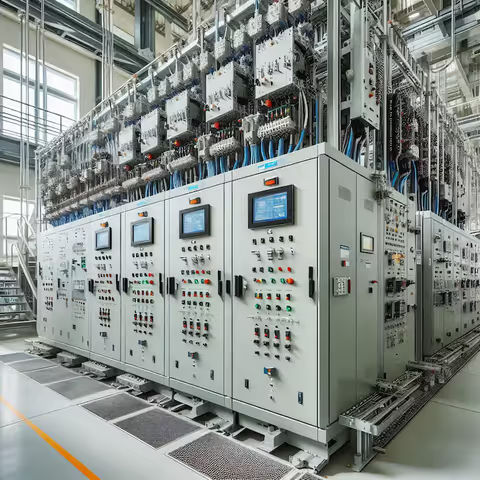
Robotic controllers coordinate movement and communication between robotic components and production systems.
Machine vision systems use cameras and image processing software for inspection, object recognition, and positioning.
Sensors monitor force, temperature, distance, pressure, vibration, and environmental conditions during robotic operations.
Industrial Internet of Things platforms collect production data from robotic systems and connected equipment for monitoring and analytics.
Simulation software helps engineers design robotic workcells and test production scenarios before installation.
Artificial intelligence platforms analyze operational data to improve robot performance, maintenance scheduling, and production optimization.
These technologies work together to create intelligent and connected industrial automation systems.
The Future of Industrial Robotics Applications
The future of industrial robotics is moving toward smarter, more connected, and more flexible automation systems.
Artificial intelligence will continue improving robotic decision-making and adaptive manufacturing capabilities.
Collaborative robots are expected to become increasingly common in workplaces where humans and robots perform complementary tasks.
Autonomous robots will likely expand into construction, agriculture, healthcare logistics, and infrastructure maintenance.
Sustainable manufacturing initiatives are encouraging robotics that optimize energy usage and reduce production waste.
Digital manufacturing environments will increasingly combine robotics, machine learning, cloud computing, and real-time analytics into connected production ecosystems.
As technology advances, industrial robotics applications will continue supporting industries that require precision, safety, consistency, and operational efficiency.
Frequently Asked Questions
What are industrial robotics applications?
Industrial robotics applications are the different tasks where programmable robotic systems perform manufacturing, assembly, material handling, inspection, welding, packaging, and other industrial operations.
Which industries use industrial robots the most?
Manufacturing, automotive, electronics, logistics, food processing, pharmaceuticals, aerospace, agriculture, and warehousing are among the industries that use industrial robots extensively.
How do collaborative robots differ from traditional industrial robots?
Collaborative robots are designed to safely work alongside people using sensors and force-limiting technology, while traditional industrial robots often operate within separated safety zones.
What technologies make modern industrial robots smarter?
Artificial intelligence, machine vision, sensors, Industrial Internet of Things connectivity, predictive maintenance, and simulation software help modern robots become more intelligent and adaptive.
Are industrial robotics applications only for large factories?
No. Industrial robotics is increasingly used by small and medium-sized businesses through flexible robotic systems, collaborative robots, and modular automation solutions designed for different production scales.
Conclusion
Industrial robotics applications have become an essential part of modern industrial automation. They help industries improve productivity, enhance product quality, support safer workplaces, and adapt to changing manufacturing demands. From automotive production and electronics assembly to logistics, healthcare, agriculture, and food processing, robots are expanding into a wide range of practical applications.
The combination of artificial intelligence, machine vision, sensors, cloud connectivity, and collaborative robotics is making industrial automation more flexible and intelligent than ever before. At the same time, safety standards, workforce training, and responsible implementation remain important for successful adoption.
As industries continue embracing digital transformation throughout 2026 and beyond, industrial robotics applications are expected to play an even greater role in building efficient, connected, and sustainable production systems across the global economy.